

Tampilkan postingan dengan label Sport. Tampilkan semua postingan
Miller Missed Pro Bowl with Shoulder Injury
 Following a sophomore season in which Broncos linebacker Von Miller
 became the team’s
all-time single-season sack king, he was named to the 2013 Pro Bowl as a
starter for the AFC squad.
became the team’s
all-time single-season sack king, he was named to the 2013 Pro Bowl as a
starter for the AFC squad.
Miller became the first player in team history to earn Pro
Bowl honors in each of his first two NFL seasons. However, he was forced to
miss the All-Star game due to an injury.
“I withdrew from the pro bowl because of my left shoulder,”
Miller said during an appearance on behalf of Gatorade in New Orleans on
Wednesday.
The injury, which Miller said would not require surgery, is
something that he has dealt with ever since his first regular-season game as a
Bronco.
He didn't miss any of the team's games in either of his
first two seasons with the injury and would have been able to play had Denver
advanced in the postseason.
“It was an injury I had lingering from my first professional
game against the Raiders last year,” Miller said. “It’s an injury that I’ve had.
It hasn’t been a problem – obviously I haven’t missed any games from it and I
wouldn’t have missed any other games from it if it was a game that we needed.
But, it was the Pro Bowl. I went and got another opinion on my shoulder so I
can be ready to go for next year.”
Miller elected to pass on the Pro Bowl in favor of beginning
the healing process so he can focus on the team’s 2013 campaign.
“It’s just rest,” Miller said of the treatment plan. “I’m
going to rest it and rehab it and get big and strong. I think I’ll be alright.
The Broncos’ training staff kept me in great health throughout my first two
years.”
Tag :
Sport,
Andy Murray sets his sights on keeping pace with Novak Djokovic
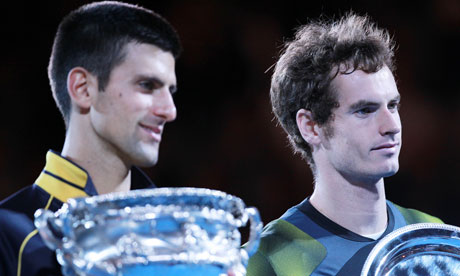
Andy Murray left Melbourne beaten but not bowed. He did
not add a second grand slam title to his portfolio after his triumph in New
York four months ago but, after analysing his defeat by Novak Djokovic in
the Australian Open final, he knows what he needs to do to keep pace with the
world No1, and to see off the challenge of Roger Federer, whom he beat in
the semi-final, and Rafael Nadal, who returns from seven months out through
injury in Chile this week.
Nevertheless Murray, still third in the world, reckons it
will be harder than ever to get to No1 – a goal many good judges reckon is
within his grasp in 2013, including Andre Agassi and Boris Becker.
"It's tough," Murray said. "If I had won here
I would have two slams, a Wimbledon final and Olympic gold and still been well
behind Novak."
"The argument a few years ago was with [Caroline]
Wozniacki being No1 without a slam – but Novak [who won one slam last year, the
Australian] still would have been significantly ahead of me even if I'd won.
With his consistency just now, Rafa [Nadal] coming back, it's going to get
tougher.
"I'll need to do well the next few months and not play
badly – especially in the Masters series, I will need to do well there. My next
goal is to try and play good tennis in Indian Wells and Miami.
"I've realised in the last year or so that when I set
myself short-term goals I tend to play better tennis that way. Previously after
every slam I would look way ahead to the next one and kind of take my eye off
the ball with the other events so that's the immediate goal and also slightly
think about the French Open. It's a tournament I'm capable of doing well in but
for me it takes a lot of practice, a lot of hours on clay to get used to it. So
that's a major goal for me but I've got to do well in the next few months.
"I obviously didn't do particularly well on the clay
until the French last year. Indian Wells wasn't good so there's obviously
potential to pick up points and improve my ranking. The way the rankings are, I
think these should be the events that dictate the majority of the rankings but
that's not always the way it works."
He has some fine-tuning to do and is slightly disappointed
that he did not build on his first-set lead against Djokovic in Sunday's final.
"Maybe not so much with tactics," he said. "I
will have a think about why I maybe didn't create as many chances on the return
as I've done in the past, but the way I was striking the ball was fine. My
tactics were right, I just didn't give myself enough opportunities on his
serve. I have to try and improve my return."
As for Davis Cup commitments in 2013, Murray said, "I'm
going to discuss it with [Great Britain's captain, Leon Smith] once I get back
from here. I spoke to him in Miami, so we will talk about it again."
Tag :
Sport,
Didier Drogba Leaves China: Inside a Failed Soccer Experiment

Last fall Zhu Jun, a Chinese Internet multimillionaire who
convinced the Didier Drogba to join his Shanghai Shenhua football club, noted that
Drogba had a two-and-a-half year contract. Despite rumors that Drogba was on
his way out, the relationship between player and team “wasn’t a one-night
stand.”
Zhu was right. The relationship between the star Ivorian
striker and the mediocre Chinese team was actually a six-month fling. Now after
half a season in a Chinese league better known for poor play and corruption—the
“Allegedly Super League,” as the Guardian once called it last year—Drogba is leaving for the Turkish
side Galatasaray. For most of Drogba’s short stay in China, talk swirled
about his imminent departure as Zhu battled Shenhua’s other owners for control
and wages for some of the team’s foreign players reportedly went unpaid. This
week the long expected exit finally happened, after Galatasaray announced it
had signed Drogba to an 18-month deal that will see him earn $13.5 million and
a per-game fee of $20,000. After the Chinese season ended in November, Drogba
had discussed playing on loan for Chelsea, the club he left last summer after
leading them to a Champions League title. The move was blocked by FIFA, the
sport’s international governing body. Shenhua are challenging Drogba’s move to Galatasaray, saying he
still has two years on his contract.
Drogba, 34, arrived in Shanghai as a conquering hero but was faced with a terribly unglamorous task: dragging Shenhua up from the basement of the Super League. He showed the same enthusiasm with which he attacked the world’s top defenses in Europe, energizing a team that was sitting in 13th place in a league of 16 teams when he arrived. Even Nicolas Anelka, a former Chelsea teammate who had come to Shenhua six months ahead of Drogba, showed moments of newfound inspiration. For most of his year in China, however, Anelka displayed the same indifference to competing that he had as a French international during the 2010 World Cup, when he led a team revolt against the coach and was sent home early. Last week Italian squad Juventus said it had signed Anelka on a loan for the remained of the season.
But while Anelka lived up to his nickname of “Le Sulk” while
at Shenhua, Drogba showed he is one of the hardest working men in the sport.
Last year he went from the European season almost directly into the Chinese
season and will now join Galatasaray’s Turkish and Champions league campaigns
after he finishes with the African Cup of Nations, where he is representing the
Ivory Coast.
He hardly takes a breather on the pitch. I watched him play
for Shenhua against Dalian Shide on a sweltering August night last year. He was
aggressive and direct—plowing into opposing players, flailing for loose balls,
crumpling at the slightest touch in hopes of drawing a foul. At one point
midway through the second half, while double-marked in the opposition corner,
he lofted a shot from an improbable angle that clanged off the crossbar. Aside
from Drogba though, Shenhua showed little guile. They often got bogged down in
midfield and had a hard time delivering the ball to their star striker. The
game ended in a scoreless draw.
For the first two months after Drogba arrived Shenhua were
undefeated in league play. They finished in ninth place, better than they were
sitting midseason but far off the team’s goal of finishing in the top four and
thus qualifying for the Asian Champions League. For Chinese football fans long
used to failure and frustration, particularly when their men’s national team
faces foreign competition, the significance of Drogba’s arrival was not just
about what he meant for Shenhua or even the Super League, but what he meant for
the sport in China as a whole. Zhu, the Shenhua chairman, told me last fall
that he thought Drogba could help elevate the country’s level of play. “In
China people don’t know what organized football is,” Zhu said. “They certainly
won’t listen to me. So I brought in a star to show them. Every day they can see
what a good player Drogba is and how he plays football. And then they will
realize what football is.”
Such justification is a bit like saying that by buying a
Ferrari you can help everyone get home faster by improving traffic flow. Still,
the wages paid at Drogba by Shanghai—he was reportedly making $200,000 a
week—plus the lucrative sponsorship deals from companies targeting the China
market, means more big names will follow. And while rich teams bankrolled by
tycoons spending their way to victory may sound wearily familiar to fans of
European soccer —
and, say, baseball in America — it’s a welcome change in China, where owners
and officials have been known to buy success more directly, by paying off a
referee or a few corrupt players. Chinese teams are still nowhere close to the
standard of those from England, Germany, Spain or Italy. But if throwing
ridiculous sums at big name players is any measure, they’re starting to even
the score.
Tag :
Sport,
